Every few months, a new astrology app drops with a slick interface and the same promise: enter your birth details, and we’ll tell you who you are. But after you’ve seen a dozen versions of the same Scorpio description, the novelty fades. What’s harder to find is a tool that doesn’t just hand you a label, but actually helps you sit with it. That’s what drew me to AstrologyWiki—not because it promised more data, but because it promised a different kind of conversation with the data.
A Quick Reality Check: What This Platform Actually Is
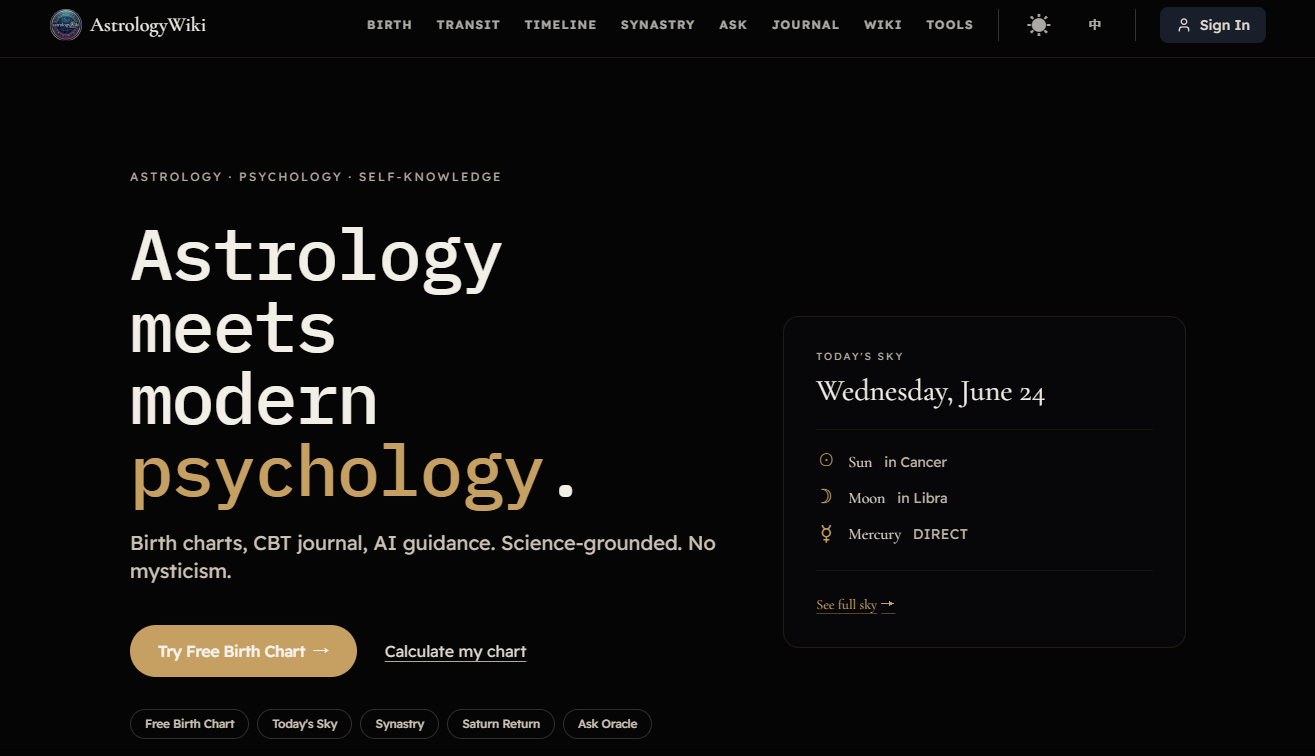
Before diving into the tools, it’s worth stating what AstrologyWiki isn’t. It’s not a fortune-telling service. It doesn’t offer personalized daily horoscopes based on your rising sign. And it won’t tell you whether you’ll get that job or meet someone new next month. What it does offer is a science-grounded approach to astrology, built on real astronomical calculations using the Swiss Ephemeris. The framing is explicitly psychological: the site describes itself as operating at the intersection of astrology, psychology, and self-knowledge.
That distinction matters because it changes how you engage with the output. You’re not looking for predictions; you’re looking for patterns.
The Birth Chart: Speed Meets Substance
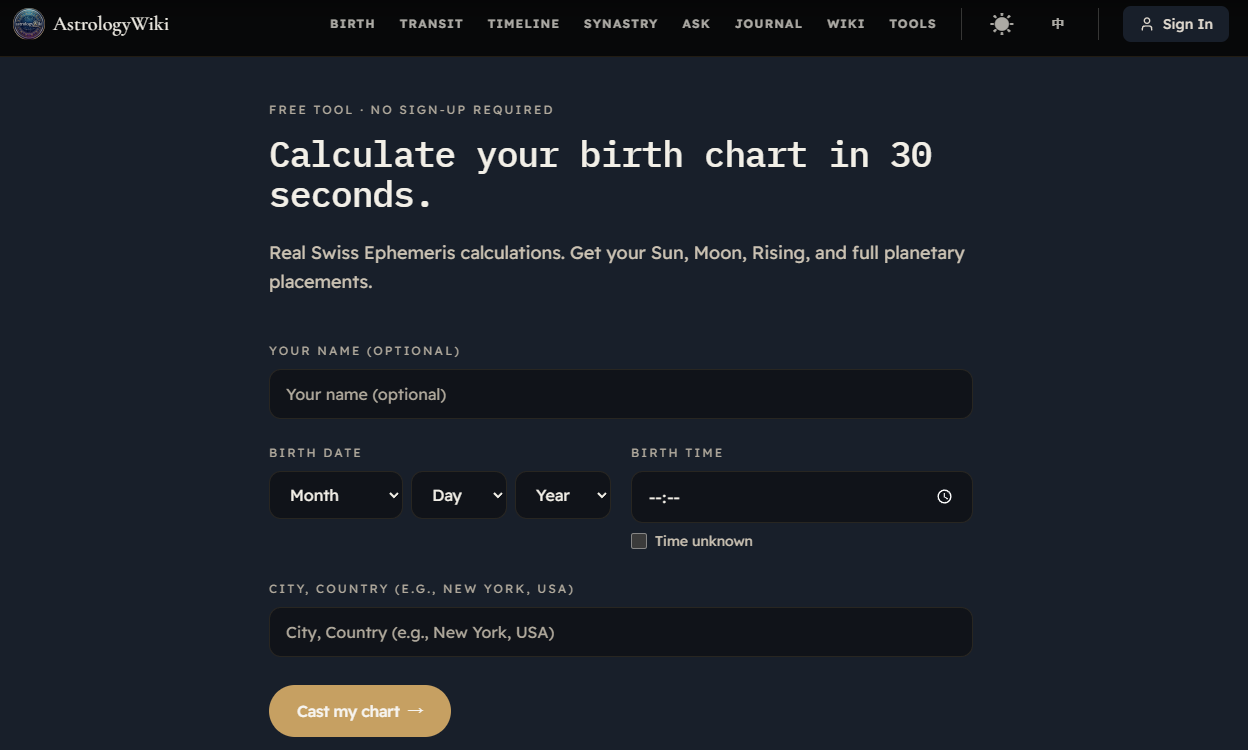
I started with the birth chart tool, entering my birth date, time, and location. The tool generated my chart in roughly 30 seconds—right in line with the site’s stated estimate. The visual output is clean: a circular chart with planets, houses, and aspects clearly marked. But the real value isn’t in the wheel itself; it’s in the interpretation that accompanies it.
Instead of generic statements about my personality, the reading framed each placement in psychological terms. My Moon sign wasn’t described as “you feel things deeply”—it was presented as a tendency in how I process emotional information and respond to stress. The difference is subtle but significant. One is a trait; the other is a pattern you can actually observe in your own behavior.
Where it falls short: The interpretation is concise. If you’re looking for a comprehensive, multi-page report with every aspect analyzed in detail, this will feel brief. But for a first pass or a regular check-in, the brevity is actually an advantage—it gives you something digestible to reflect on without overwhelming you.
Today’s Sky: A Daily Lens Without the Hype
The Today’s Sky tool shows current planetary positions and transits. I tested it over several days to see whether the descriptions felt generic or grounded in actual sky data. Each day’s summary referenced specific planetary aspects that were mathematically present at that time—not recycled horoscope copy.
One morning, the transit description highlighted a Venus-Neptune trine, noting that it “softens boundaries” and makes it “easier to connect with others on a soulful level,” while also advising to “stay grounded to avoid idealizing people or situations”. That kind of framing is useful not because it tells you what will happen, but because it gives you a lens for noticing what might be showing up in your interactions that day.
From a practical user perspective, this works best as a brief morning ritual. It takes about two minutes to read and offers a thematic prompt for the day without veering into superstition or overpromising.
Synastry: Relationship Astrology Without the Soulmate Gloss
The synastry tool overlays two birth charts to show “where they meet, clash, and recognise each other”. The site explicitly positions this as “relationship astrology without the soulmate gloss”—which is a refreshing departure from the usual twin-flame rhetoric.
I tested it by comparing my chart with a close friend’s. The output highlighted areas of harmony and tension in terms of communication styles, emotional needs, and conflict patterns. The interpretations avoided deterministic language about whether the relationship is “meant to be.” Instead, they framed the dynamics as tendencies—patterns that might require more attention or that flow more naturally.
The limitation: Like the birth chart tool, the synastry interpretation is relatively brief. It gives you a solid overview but won’t walk you through every single aspect in the overlay. For a quick relationship check-in, it’s more than adequate. For a deep-dive analysis, you’d need to supplement it with additional resources.
How AstrologyWiki Actually Works: A Walkthrough
The platform keeps its feature set intentionally small. As the site puts it: “A small set of sharp instruments. Not 50 features”. Here’s exactly how the core tools function.
Step 1: Generate Your Birth Chart
Enter Your Birth Data
The birth chart tool asks for three inputs: birth date, birth time, and birth location. The location field auto-suggests cities as you type. No account creation is required at any point—you can generate a chart immediately.
Review the Chart and Interpretation
Once you click calculate, the chart appears alongside a summary of your Sun, Moon, and Rising signs, plus a breakdown of planetary placements by house. The interpretation is delivered in plain English with a consistent psychological framing. The result may vary depending on the accuracy of your birth time—if you’re unsure, the house placements will be affected.
Step 2: Check Today’s Sky
View Current Transits
This tool loads automatically with the current date and time. It displays a list of active planetary transits, each with a brief psychological interpretation. No input required—just open and read.
Reflect on the Day’s Theme
Each transit description focuses on internal dynamics rather than external events. The tone is observational, not prescriptive. It’s designed to prompt reflection, not action.
Step 3: Run a Synastry Comparison
Enter Two Birth Charts
The synastry tool accepts birth data for two individuals. Like the other tools, it requires date, time, and location for each person. The comparison generates an overlay chart showing how each person’s planets interact with the other’s.
Review Relationship Dynamics
The output highlights areas of harmony and tension between the two charts. The interpretations focus on compatibility in terms of communication, emotional needs, and conflict patterns—again, avoiding deterministic language about whether the relationship is “destined” to work or fail.
The Wiki: A Living Library That Grows With You
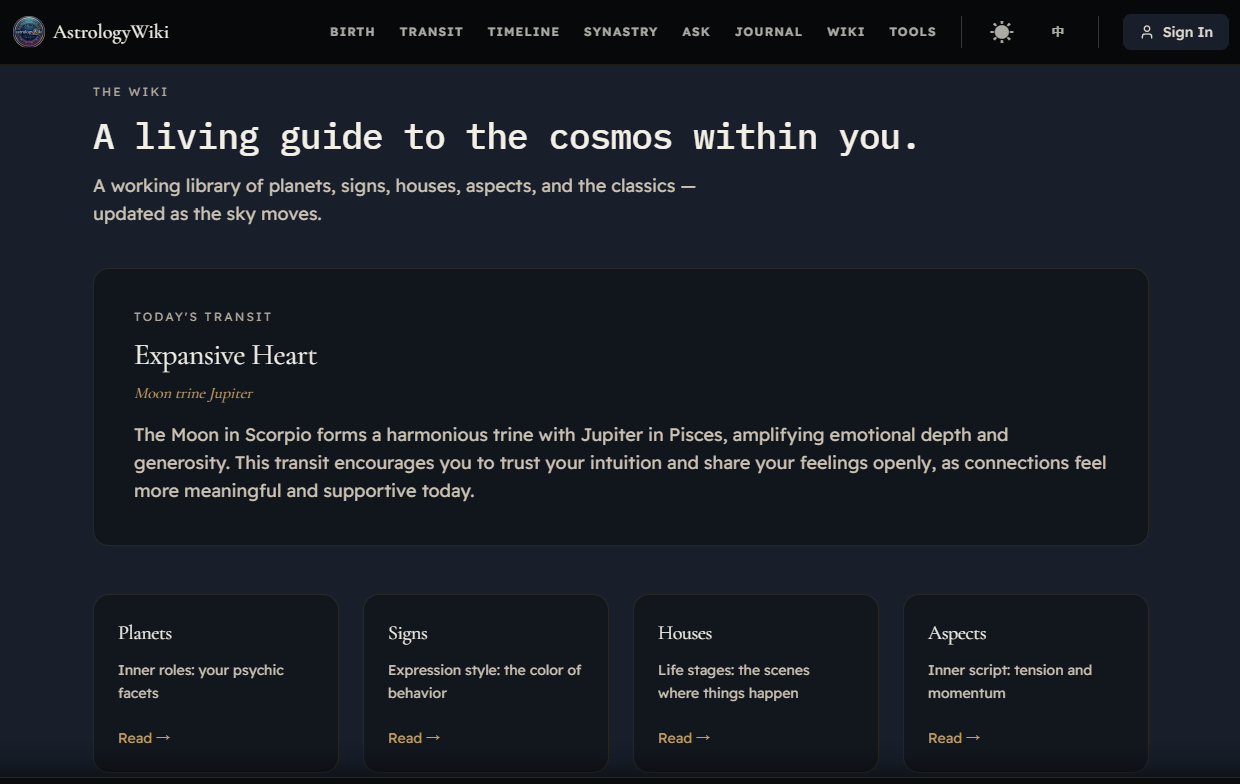
One feature that adds significant value is the integrated Wiki, described as “a living guide to the cosmos within you” and “a working library of planets, signs, houses, aspects, and the classics — updated as the sky moves”. When you encounter a term you don’t fully understand, you can click through to an explanation without leaving the page.
The Wiki also includes longer-form essays on charts, cycles, and the psychology behind them—written to be useful rather than mystical. During my testing, I found myself referring to the Wiki frequently, especially when interpreting aspects I wasn’t familiar with. The entries are accessible without being dumbed down, which makes the platform more approachable for beginners while still offering depth for intermediate users.
Ask Oracle: AI Guidance Without the Jargon
The Ask Oracle feature answers astrology and psychology questions in plain language. I tested it with a few questions about specific chart placements and transits. The responses were direct and avoided horoscope clichés. It’s not a replacement for a human astrologer, but it’s useful for quick clarifications when you’re reading your chart and want an immediate explanation.
Where AstrologyWiki Excels and Where It Doesn’t
To give a balanced view, I compared AstrologyWiki against other free astrology platforms I’ve used. The differences come down to philosophy as much as features.
| Aspect | AstrologyWiki | Typical Free Astrology Tools |
| Entry Barrier | No sign-up, no email required | Often require account creation |
| Interpretation Style | Psychological, observational | Predictive, event-focused |
| Tool Set | Small, focused set of core tools | Often cluttered with features |
| Learning Curve | Low—Wiki is integrated on-site | Medium to high—jargon without explanation |
| Depth of Analysis | Concise but meaningful | Varies widely |
| Tone | Neutral, reflective | Can be alarmist or overly optimistic |
The main constraint is brevity. If you’re looking for a comprehensive, multi-page report with every possible aspect analyzed, this isn’t the platform for that. The interpretations are designed to be digestible, not exhaustive. That works well for a quick check-in or a first pass at understanding your chart, but power users may want more.
Another practical consideration: the quality of the output depends heavily on the accuracy of your input. Birth time is critical for house placements. If you’re guessing your time of birth, the chart will still generate—but the house interpretations may not be meaningful. The tool doesn’t flag this as a potential issue, which could lead to misunderstandings for casual users.
Who Benefits Most From This Approach?
Based on my testing, AstrologyWiki is best suited for:
- Curious beginners who want a low-pressure introduction to astrology without the mysticism.
- Psychology-minded individuals who are more interested in self-reflection than fortune-telling.
- People who value convenience—the tools are fast, free, and require no commitment.
- Anyone skeptical of traditional astrology but open to using celestial patterns as a framework for self-awareness.
It’s less ideal for:
- Professional astrologers who need granular data and advanced charting features.
- Users seeking detailed predictive forecasts—the platform intentionally avoids this.
- Anyone who prefers in-depth, lengthy reports over concise summaries.
A Few Honest Caveats
No tool is perfect, and AstrologyWiki has its quirks. In my experience, the interpretations are consistently thoughtful but not always personally resonant—which is true of any generalized system. The result may vary depending on how closely the psychological framing aligns with your own self-perception.
The Today’s Sky tool is useful but brief. If you’re hoping for a daily ritual that takes more than a few minutes, you’ll need to supplement it with additional reading or journaling.
And while the integrated Wiki is helpful, it’s not a substitute for a dedicated learning resource. It answers questions in the moment but doesn’t offer a structured curriculum for deeper study.
A Tool That Respects Your Intelligence
AstrologyWiki isn’t trying to be the most powerful astrology platform on the web. It’s trying to be the most usable one for people who want to explore astrology as a psychological tool rather than a predictive system. And in that regard, it succeeds.
The astrology wiki integration makes the experience feel cohesive—you’re not jumping between tabs to understand what you’re looking at. The tools are fast, the interpretations are grounded, and the overall tone is refreshingly free of hype.
If you’ve ever opened a birth chart and felt overwhelmed by the jargon, or if you’ve dismissed astrology altogether because it felt too superstitious, this platform is worth a look. It won’t tell you your future. But it might help you understand your present a little better.